
The garden extension
In 2022 I acquired a new plot of land from one of my neighbours. It is about 600 square metres, half the size of my existing garden.
The site had been neglected for over a decade, and it included two dilapidated greenhouses and a large enclosure surrounded by netting and supported by metal rods for the growing and protection of raspberry plants.
The whole area had also been a repository for an eclectic mix of unwanted objects, including a gas cylinder, an old radio and broken garden tools.
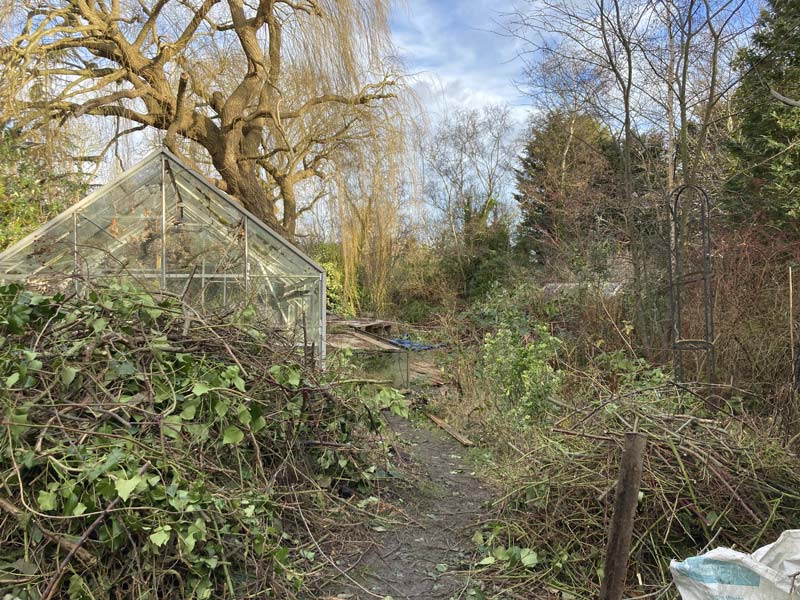
The extension as I acquired it: overgrown, with dilapidated greenhouses
It was totally invaded by brambles and ivy, and the shrubs planted there – mostly Portuguese laurels, cotoneaster, pyracantha and euonymus – were completely overgrown.
Pluses…
My neighbour had planted many now beautiful mature trees, including many silver birches and maples, and also a large oak and a magnolia. These are already giving my new garden a readymade structure.
There were also unexpected surprises: a few ferns enjoying their semi-shade positions near the trees and a gingko biloba, and a fig tree which had been cut right back but were sprouting from the base. The gingko only appeared once the growing season was well under way, as it was hidden amongst large round logs piled near the entrance to the site, the result of a huge eucalyptus which had been felled over fifteen years ago after it became unsafe.
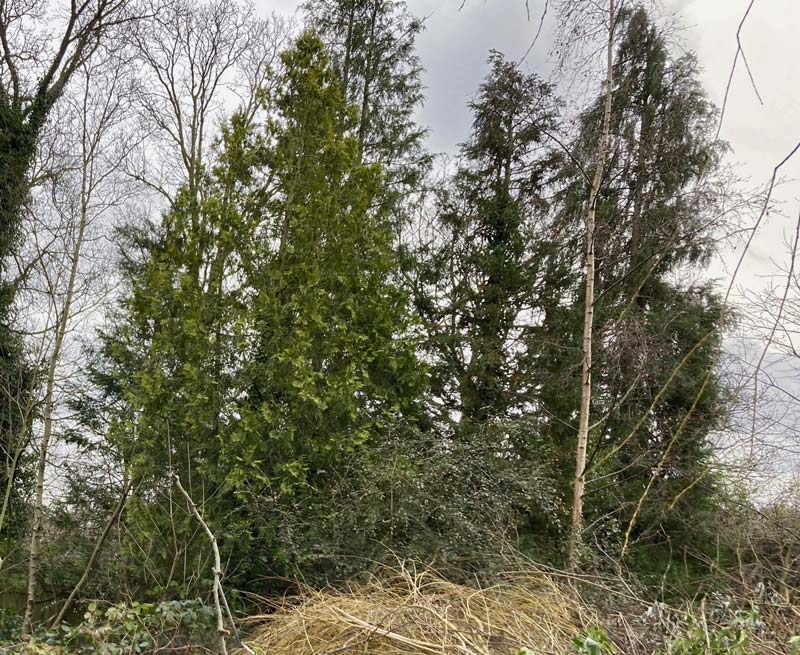
Ugly conifers – who needs them
…and minuses
Less desirable were the seven not so attractive conifers of the Leylandii variety, which cast a lot of shade over the whole plot, and a ‘Kifsgate’ rambling rose.
I was responsible for planting twenty years ago, and which had invaded a large part of my new domain as well as the alleyway adjacent to it.
The legal wrangle
Before I could give myself wholeheartedly to the clearing and development of my new garden, I had to go through a lengthy and tortuous legal process.
It took nearly six months to complete, due to an obstructive solicitor acting for my neighbour, and the Equity release company he had dealings with. It was all very stressful, and my solicitor, my neighbour and I were tearing our hair out with frustration.
But why do it?
However, a question remains: why would I want to take on such a big challenge at this stage of my life? The answer is manifold.
The most important factor behind my keenness – verging on an obsession – to purchase this land, is the bequest of my garden and house I made last year to Perennial, The Gardeners’ Royal Benevolent Society. This charity would ensure that my garden would survive and carry on into the future.
The new extension would be an added bonus, particularly with the proposed installation of a new large greenhouse. This would allow the propagation and dissemination of not only a new generation of Corokia, which have been seeding themselves freely in my garden, but also other unusual New Zealand plants which I have been growing.
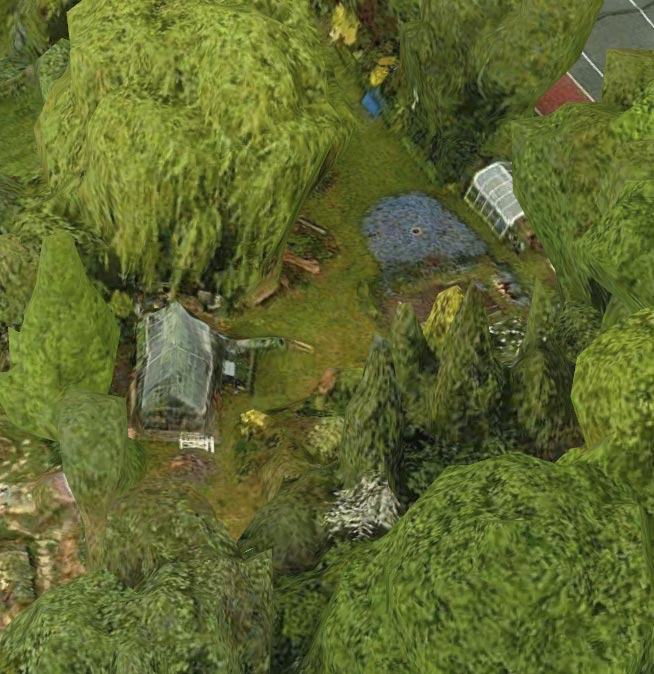
The extension as I acquired it, complete with old greenhouses, courtesy of Apple Maps
Another reason is that, having run out out of space in my existing garden, this new acquisition will afford me the opportunity for adding to my planting scheme and trying out a new way to create this new garden.
Sustainability
I have decided to take on the most exciting challenge: to make this new environment sustainable by using all the materials afforded by the site itself, not only the logs and branches from the felled trees and cut back stems of the overgrown shrubs, but also lumps of the concrete base on which the previous dilapidated greenhouse sat. Recycling and reusing all this material will dramatically reduce the garden’s carbon footprint.
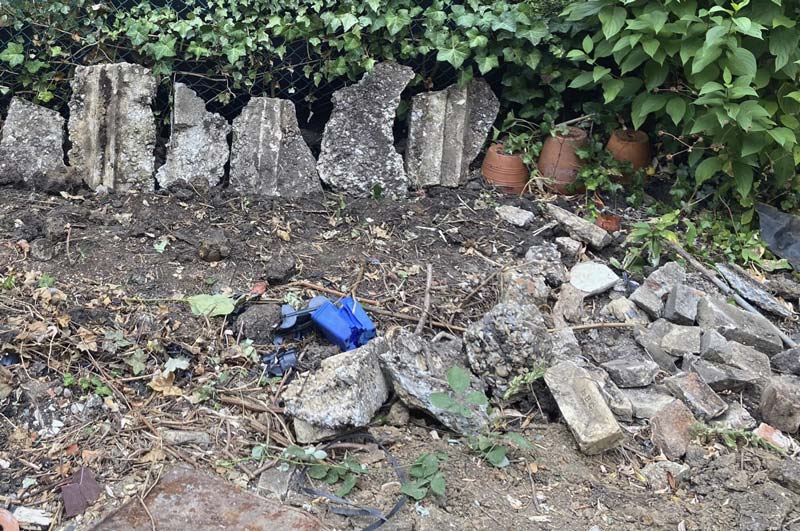
Even the concrete base of the old greenhouse was repurposed
So once the big legal hurdle had been dealt with, the massive clearing operation could take place. The two greenhouses were dismantled and taken away, leaving loads of broken shards of glass behind, and the general rubbish disposed of.
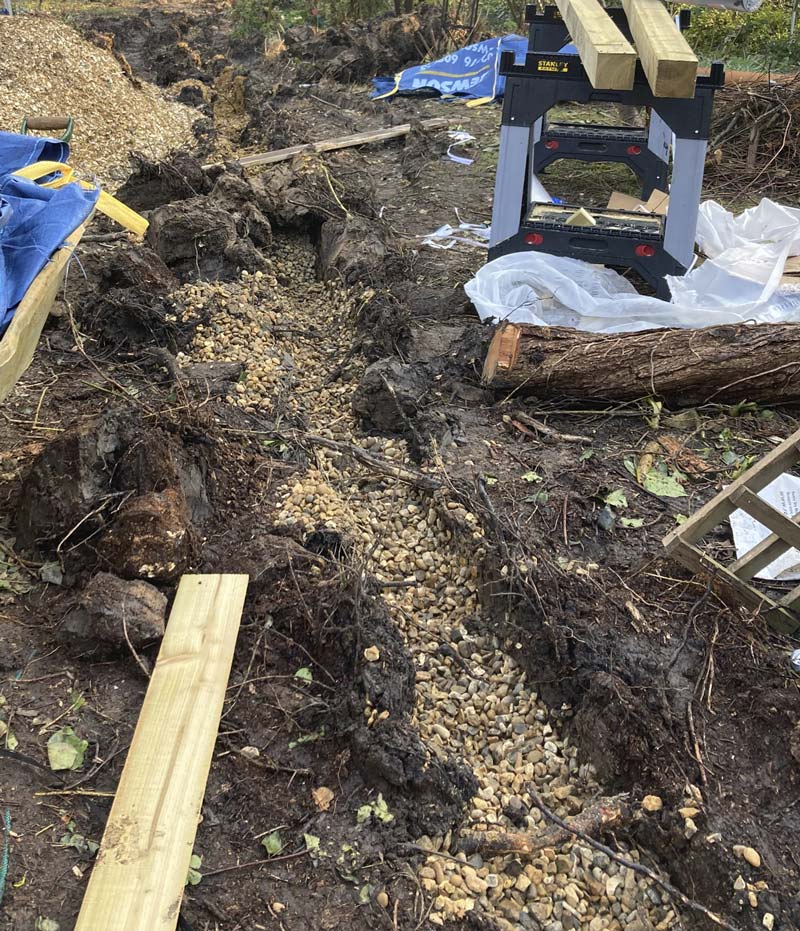
Digging the trench for drainage pipes
Five of the seven conifers were felled, and all the lanky shrubs cut back. The ‘Kifsgate’ rose took many sessions to cut down, as the very long and spiky branches were difficult to handle. I have learned my lesson: no more rambling roses! The digging out of brambles and ivy is ongoing.
Drainage issues
As this new land is situated at the bottom of a gentle slope of 100 metres, it tended to flood every year, as was the case when I first saw it in November of last year.
A soak-away was created as a matter of priority. Trenches were dug and filled with gravel, and drainage pipes leading to a sump at the bottom of this new garden.
Chop and shred
With the necessary power tools (including a heavy duty shredder, a battery powered chainsaw and drill), logs were cut to size, trees and shrubs pruned, and large amounts of wood chipping produced. These were added to considerably by the recent pollarding of the gigantic weeping willow next door.
The tree surgeon was able to leave me with more logs and a mountain of new willow mulch by using my own shredder. As a result the logs and branches did not need to be removed and disposed of, but left behind to be reused productively.
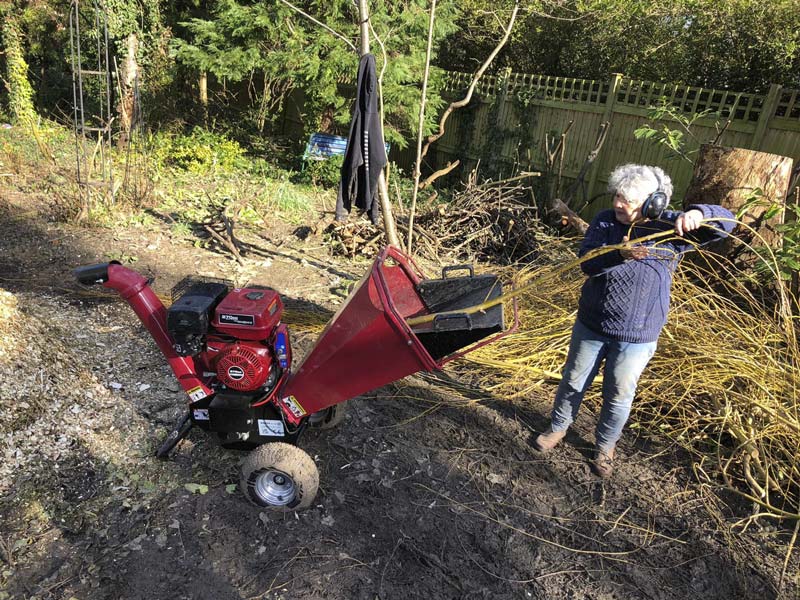
The tree shredder allowed me to repurpose the old willow into a mountain of new mulch
Getting down to gardening
The landscaping proper has now started in earnest. An exotic area has been created on the site of the old dismantled greenhouse. Ten tons of topsoil – which had to be imported and brought in by wheelbarrow – were needed before the plants could go in.
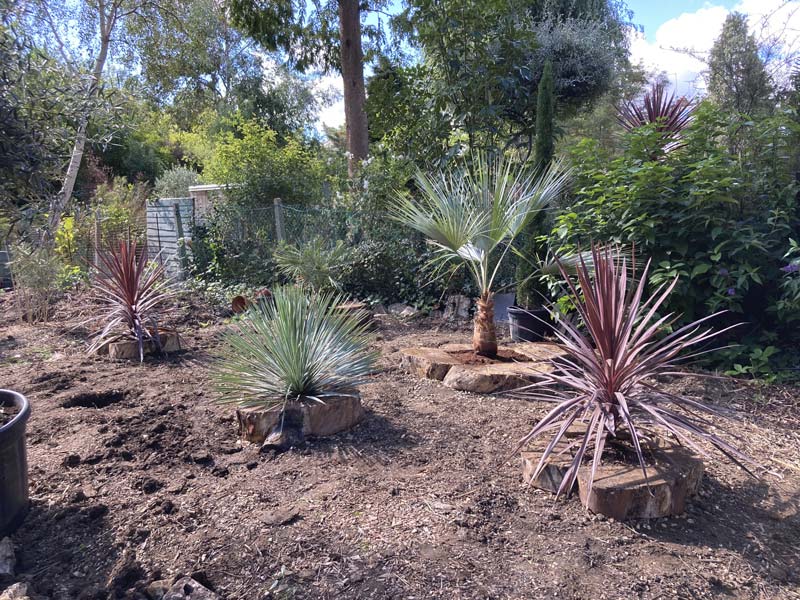
Ten tons of topsoil were imported, and felled logs were used to protect the more exotic plants
The existing large eucalyptus logs, cut in half, have been used creatively to frame each plant, namely: a ‘Brahea armata’, a ‘Yucca rostrata’, a couple of purple ‘Cordylines’ and a ‘Chamaerops cerifera’.
The olive tree
A 200 kilo, three-metre-high large olive tree has been dragged down the long alleyway and pushed into its final position.
Digging a large hole and manhandling it into it was also a mammoth operation.
Watch the video to see Jay and Bryan struggling to move it, cut the pot away, and tip it into its hole before adding chipping and topsoil to complete the process.
Preparing the ground
Soil preparation for the proposed ‘Prairie’ area was also carried out in a sustainable way using home made organic material.
A large pile of unwanted ivy, brambles and weeds were burned creating ash, to which my own leaf mould, compost and wood shredding were added. A final thin layer of imported top soil completed the job.
Looking to the future
Going forward, the new garden extension will include an exotic border, a woodland area, prairie planting, and a raised border framed by the felled conifer logs displaying Mediterranean shrubs and trees. A new greenhouse will be the centre of future propagation of my Corokia and other unusual New Zealand plants.
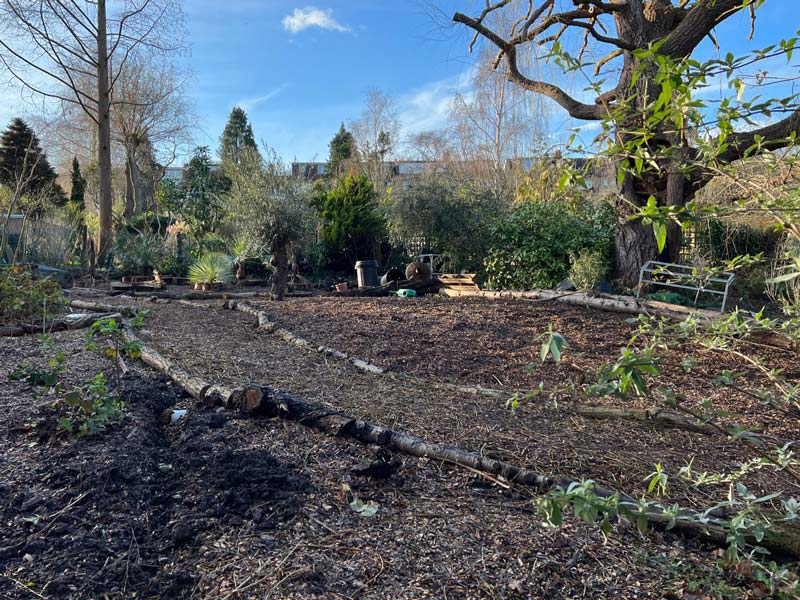
The garden as it stands in January 2023